
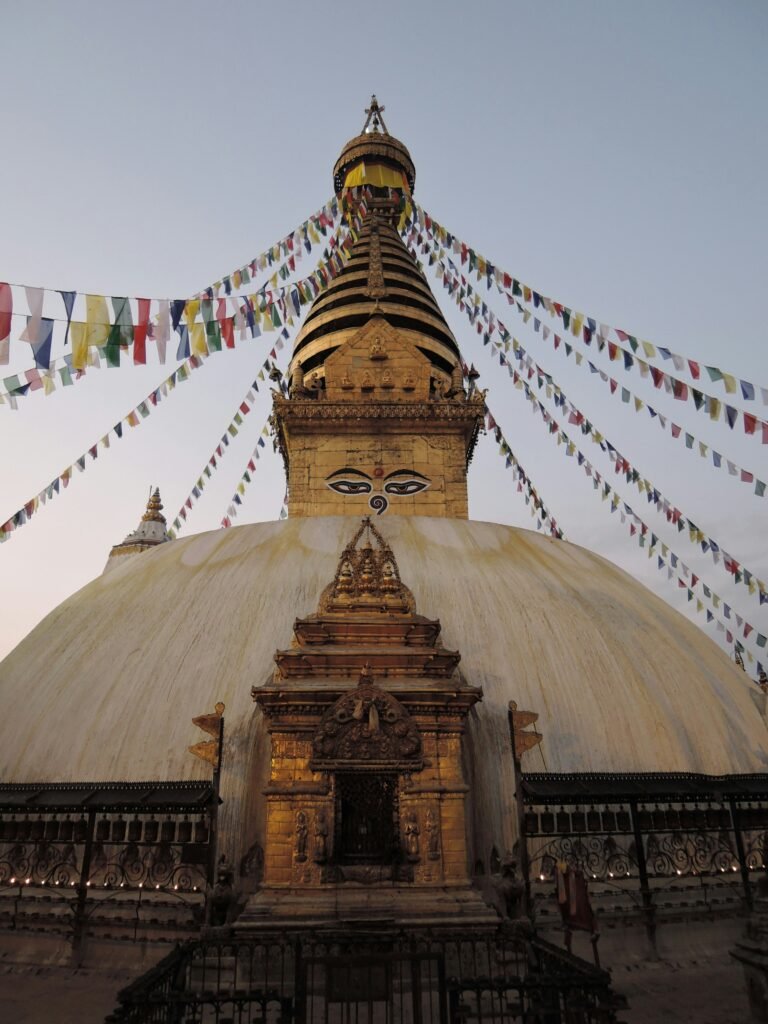
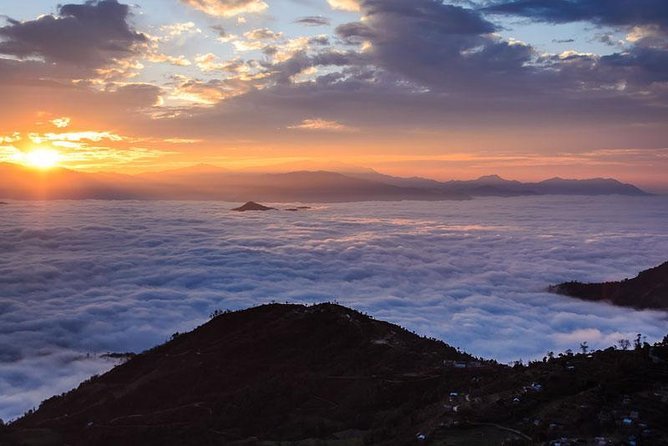
Imagine standing on a hill, looking out over a sea of thick winter fog that fills the entire Kathmandu Valley. For a moment, only the white dome and golden spire of the Svayambhu Stupa are visible, floating like a lotus on the heaving clouds. This isn’t just a beautiful view—it’s a glimpse back in time to the very birth of Nepal.
According to the ancient Svayambhu Purana, the Kathmandu Valley wasn’t always a bustling capital; it was once a vast, deep lake known as Nagavasahrada, the “Lake of the Serpent Kings”
A Force Beyond the Blade
The legend tells us that the Great Bodhisattva Manjushri arrived from the north to pay homage to a miraculous, self-existent flame (the Svayambhu) glowing in the center of the lake. Determined to make this holy site accessible, he performed a survey of the mountains to find a way to drain the waters.
While the stories describe Manjushri using his mighty sword, Chanda Hasa (“Dreadful Laugh”), to cleave the mountains at Chobar Gorge, the truth is even more profound. In the traditions of Vajrayana Buddhism, this sword is a symbol for the power of Mantra. The “strike” was actually the result of Manjushri’s intense meditation, which released a spiritual energy so powerful it triggered a massive earthquake that severed the valley’s rim at its weakest point.
Where Myth meets Science
What makes this story incredible is that modern science agrees with the “seismic” nature of the event! Geologists have discovered that the valley floor is covered in hundreds of meters of lacustrine clay and sand—the kind that only forms at the bottom of a still lake.
The “sword strike” describes a real geological phenomenon: the Chobar Gorge was indeed ruptured by an earthquake, and visible faults can still be seen in the gorge walls today. Scientific core drilling shows that the lake underwent major drainage events around 48,000 and 38,000 years ago, triggered by tectonic activity rather than climate change
Three Must-Visit “Mythic” Sites
When you travel to Kathmandu, you walk through these legends:
- Svayambhu Hill: Visit the “Self-Created” stupa where the primordial light first appeared. It is the spiritual heart of the valley.
- Chobar Gorge: Stand at the very spot where Manjushri is said to have swung his sword. You can still see the sheer walls of the gorge that were split by ancient seismic forces
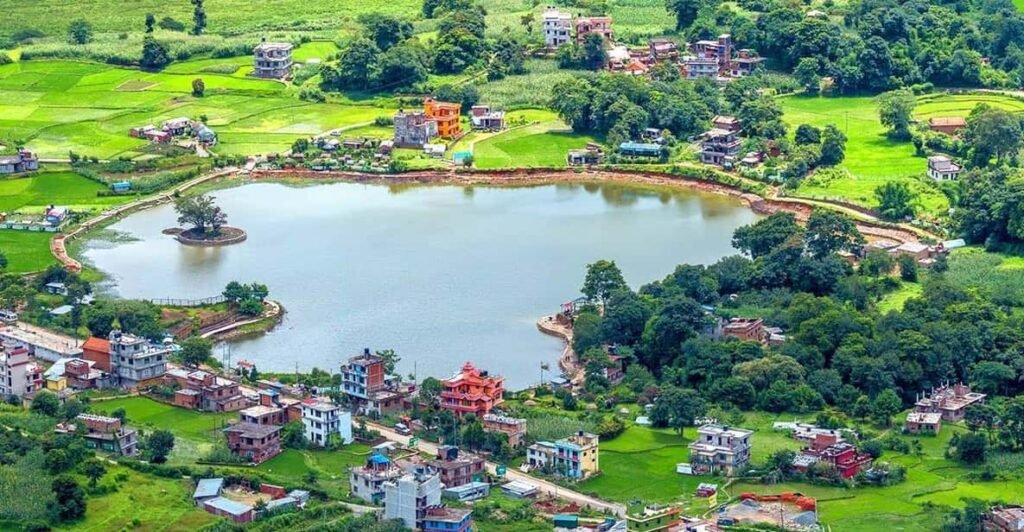
- Taudaha Lake: Legend says that when the water drained, the Serpent King Karkotaka was persuaded to stay in this specific lake to ensure the valley remained fertile and received rain. Locals still believe he lives in his underwater palace of jewels to this day.
Are you ready to walk where gods once carved the earth? The Kathmandu Valley is a place where history isn’t just found in books—it’s written in the rocks beneath your feet and the shrines on every corner.